
That is the short version. The details, like who sits where, whether you kneel and what exactly you say, are what brides message us about the week before the wedding. This guide answers all of them, and finishes with the part we know best: what to wear so you can kneel, pour and pose comfortably.

The Tea Ceremony at a Glance
| What it is | The couple serves tea to their elders to show respect and to be welcomed into each other’s families |
| When | On the wedding morning, after the fetching of the bride and the gatecrash |
| Where | At the groom’s home and the bride’s home, or both families together at one venue |
| Order | Most senior first, usually the groom’s side before the bride’s side |
| How long | About 30 to 60 minutes per side, depending on how many relatives attend |
| What you say | The elder’s title, then 请喝茶 (qǐng hē chá), “please drink tea” |
What Is the Chinese Wedding Tea Ceremony?
The tea ceremony is the moment the couple formally greets each other’s families as married members. By offering tea, you thank your elders and show respect. By drinking it, they accept you. In return, they give their blessings along with red packets, gold jewellery or both.
For many Singapore families, it is the most emotional part of the morning. It is also one of the most photographed, so it helps to know the flow before the day.
When Does the Tea Ceremony Happen?
A typical Chinese wedding morning in Singapore runs like this:
- Hair combing ceremony (上头), the night before, at each of your homes
- Fetching the bride, with the gatecrash games at the bride’s door
- Tea ceremony
- Solemnisation, if you are not holding it on a separate day
- Wedding lunch or dinner banquet
Which home comes first? Traditionally, the couple serves tea at the groom’s home first, then returns to the bride’s home. This is what most Singapore guides and emcees follow today, and the old “return visit to the bride’s family three days later” has simply moved to the same day. Some families, including some Teochew families, serve the bride’s side first, before the couple leaves her home. Many couples now hold one combined ceremony at a single venue, and the groom’s side still usually goes first.
Tea Ceremony Sequence: Who to Serve First
The rule is simple: most senior first. Where families differ is at the very top, between parents and grandparents. Here is the order most Singapore families use:
| Order | Who you serve |
|---|---|
| 1 | Parents (some families serve grandparents first) |
| 2 | Grandparents, paternal before maternal |
| 3 | Grand-uncles and grand-aunts |
| 4 | Uncles and aunts, paternal before maternal, eldest first |
| 5 | Older married siblings and cousins, with their spouses |
| 6 | Older unmarried siblings and cousins |
| 7 | Younger siblings, cousins, nieces and nephews serve you, and you give them red packets |
Two family-specific points are worth settling a week before:
- Parents or grandparents first? Many families serve the parents first, because they are the hosts. Others insist the grandparents come first out of respect. Ask both sets of parents and write the answer down.
- Elders come in pairs. Married couples are served together. If an elder’s spouse is alive but cannot attend, pour an extra cup on their behalf.
Print the list for each side and give it to your helper or emcee. Nobody should be guessing names in the middle of the ceremony.
How to Serve Tea, Step by Step
- Set up. The elders sit on chairs. The couple stands or kneels on red cushions in front of them. Many emcees follow 男左女右, men on the left and women on the right, for both the elders and the couple.
- Prepare the tea. A helper, often a sister or the Dai Kum Jie, pours the tea about two-thirds full and places the cups on a red tray.
- Offer with both hands. Hold the cup or saucer with both hands and offer it to the elder. Offering with one hand is seen as disrespectful.
- Say the greeting. Use the elder’s title followed by “please drink tea”, for example 爸爸,请喝茶 (bàba, qǐng hē chá).
- The elder drinks and blesses you. They take a sip, return the cup to the tray and say a few words of blessing.
- Receive the gift with both hands. The elder gives a red packet or jewellery. If it is jewellery, the elder or your helper may put it on you straight away. Do not open red packets during the ceremony.
- Move to the next elder while the helper refills the cups.
Do you have to kneel? No. Kneeling is the traditional form, but standing or bowing is widely accepted, especially if you are wearing a heavy qun kua or are pregnant. One Singapore wedding emcee estimates that around 60% of couples now stand. The one rule: be consistent. If you kneel for one family, kneel for the other.
What to Say: A Simple Tea Ceremony Script
You do not need a long speech. The title plus 请喝茶 is enough, and English is perfectly fine if your family speaks it at home. These are the titles you will use most:
| You are serving | Mandarin | Pinyin |
|---|---|---|
| Father / Mother | 爸爸 / 妈妈 | bàba / māma |
| Paternal grandfather / grandmother | 爷爷 / 奶奶 | yéye / nǎinai |
| Maternal grandfather / grandmother | 外公 / 外婆 | wàigōng / wàipó |
| Father’s older brother / younger brother | 伯伯 / 叔叔 | bóbo / shūshu |
| Mother’s brother | 舅舅 | jiùjiu |
Hokkien and Teochew families often use dialect titles instead, such as a-gong and a-ma for grandparents. Use whatever the elder is used to hearing from you.
Elders usually reply with a blessing such as 百年好合 (bǎi nián hǎo hé, a hundred years of harmony), 早生贵子 (zǎo shēng guì zǐ, children soon) or 白头偕老 (bái tóu xié lǎo, grow old together). When the younger relatives serve you, a simple wish such as 学业进步 (xué yè jìn bù, do well in your studies) is a sweet touch.
Tea Ceremony Ang Bao: Who Gives What?
- Elders to the couple: red packets, gold jewellery or both. The groom’s mother often gives the bride gold such as si dian jin or bangles. There is no standard amount. It is entirely up to each elder.
- The couple to younger relatives: when younger siblings and cousins serve you, you give them a red packet. Small amounts such as S$8, S$18 or S$28 are common. Prepare these in advance and keep them with your helper.
Tea Ceremony Checklist
- A tea set (traditionally part of the bride’s dowry)
- Tea with red dates, longans and lotus seeds for sweetness and many children. Do not cut the lotus seeds in half, because halves suggest separation.
- A red tray and spare cups
- Two red kneeling cushions, if you are kneeling
- The printed serving order for each side
- A box or pouch for red packets
- Red packets for the younger relatives
- One helper per side who knows the family
How Long Does a Tea Ceremony Take?
Allow 30 to 60 minutes for each side, depending on the size of the family. A family of 15 to 20 relatives takes around 30 to 45 minutes. If you are doing both sides at one venue, plan for 90 minutes or more, and tell your photographer and makeup artist so the morning timeline has room for touch-ups between sides.
What Should the Bride Wear for the Tea Ceremony?
You will kneel or bow many times, hold cups with both hands, receive jewellery and pose for group photos with every branch of both families. The right outfit makes all of that easy. Brides in Singapore usually choose one of three options.
1. The traditional qun kua (裙褂)
The red qun kua with gold embroidery of dragons, phoenixes and peonies is the most traditional choice, especially for Cantonese families. It is beautiful and meaningful, but it is also heavy and warm. If you choose one, make sure it is fitted for your shoulders and try kneeling in it before the day.
2. A modern cheongsam or cheongsam-inspired gown
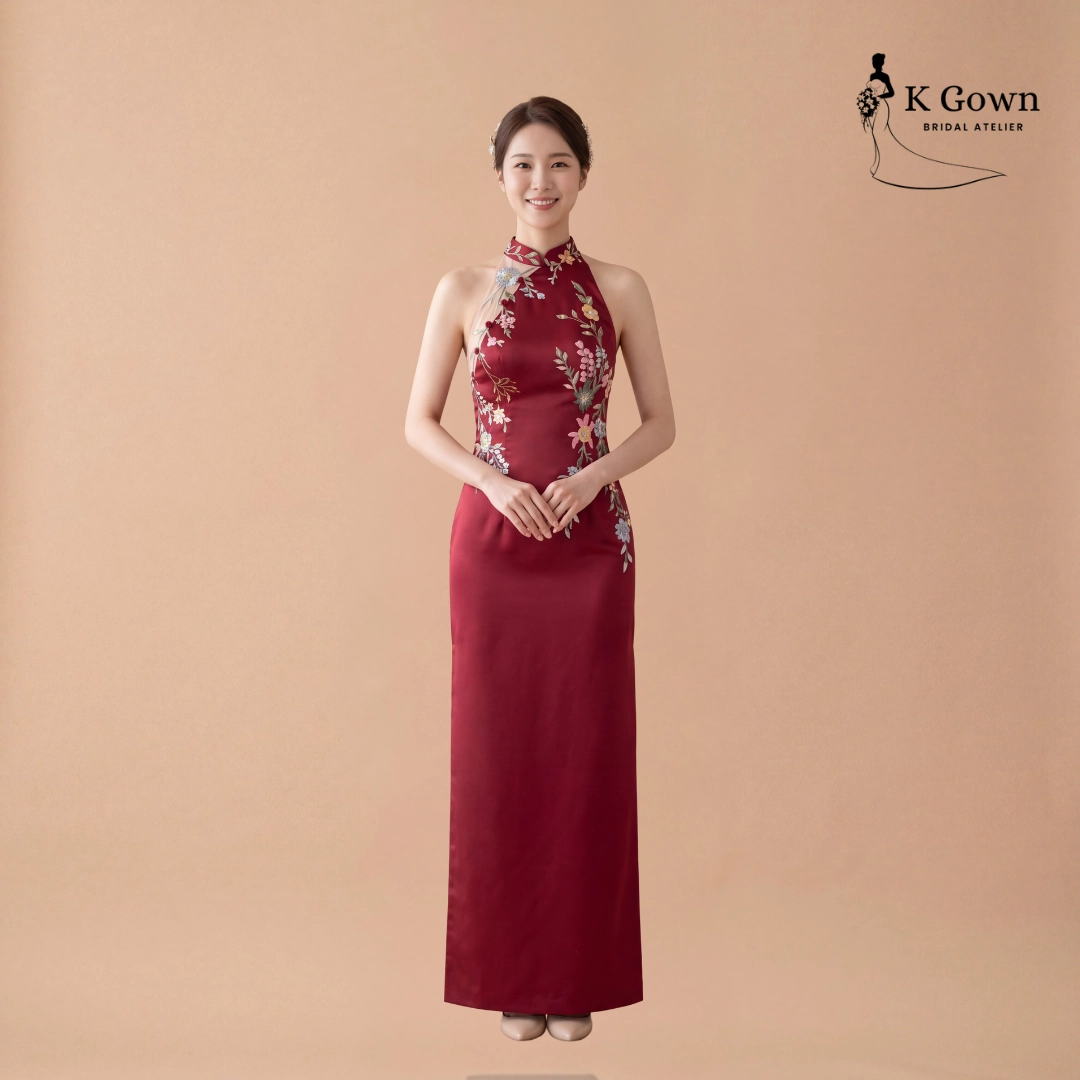
This is what most of our brides choose today. A red, burgundy or embroidered cheongsam honours tradition, looks elegant in photos and is far easier to move in. Look for a slit or an A-line skirt so you can kneel and stand without tugging at your hem.
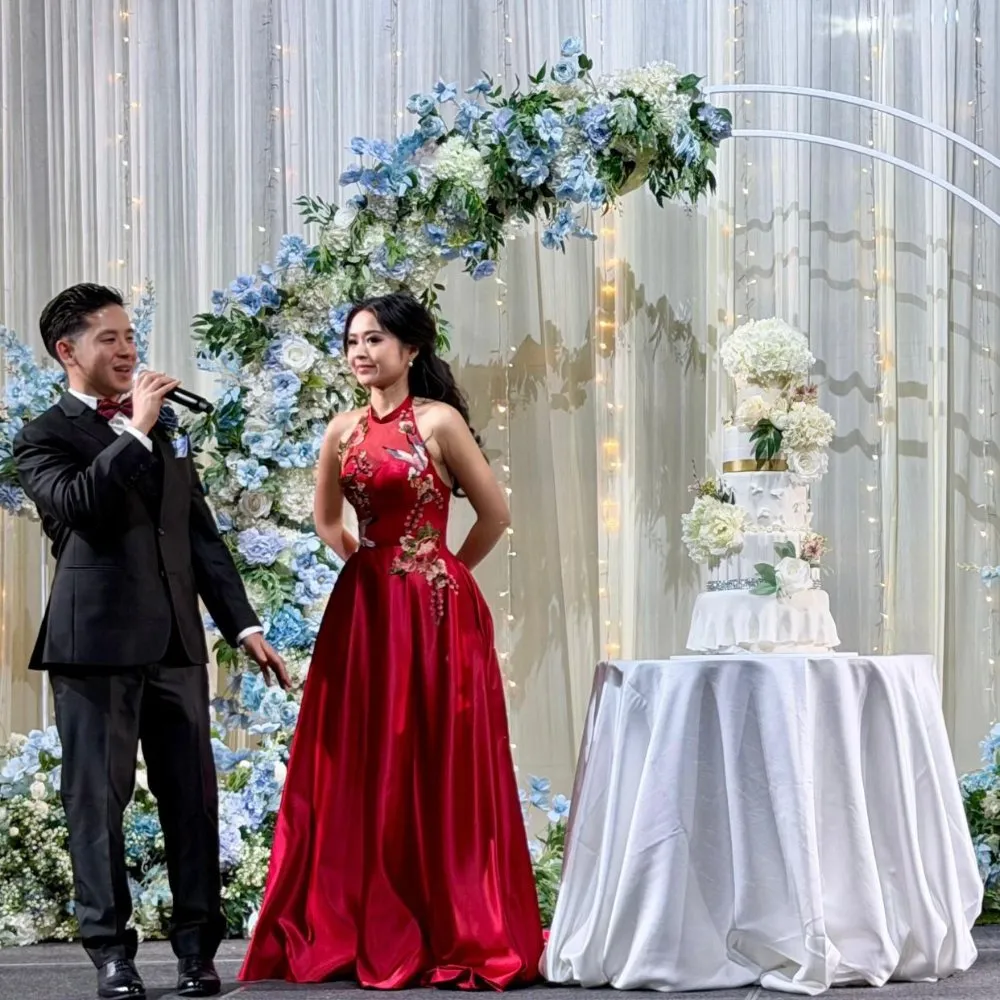
One of our brides, Marryanne, came to us specifically for her tea ceremony dress. She had already rented two gowns elsewhere, but she wanted to own this one. Our designer Kim created a red gown with a cheongsam neckline and oriental floral embroidery to suit her petite frame, and added pockets for the red packets she would collect through the day. The hem was also built so it could be shortened to knee or ankle length after the wedding. In her words, it was “one of the best wedding purchases” she made.
3. Your wedding gown
Some couples serve tea in the wedding gown they will wear for the banquet, especially when the tea ceremony runs straight into the solemnisation. That is completely acceptable. A common pattern is to wear the gown for the groom’s family and change into a cheongsam or kua for the bride’s family, or the other way around.

If you want one look that bridges both, a modern cheongsam wedding gown with pastel pink lace gives you a mandarin collar for the tea ceremony and a full gown silhouette for the solemnisation. For plus-size brides, our red cheongsam-inspired A-line gown is comfortable for kneeling and very forgiving in photos.
Our stylist tips for the tea ceremony
- Do a kneel test at your fitting. Kneel, stand and bow in the dress. If the hem catches or the seams pull, ask for the slit or the skirt to be adjusted.
- Leave room for the gold. A mandarin collar or a clean neckline gives a si dian jin necklace a place to sit, and short or no sleeves make it easy to slip on bangles.
- Think about pockets. You will be handed red packets all morning. Pockets, or a helper with a pouch, keep your hands free.
- Plan the outfit change. If you change between sides, book your makeup artist for the extra touch-up and leave 20 to 30 minutes in the timeline.
Our Actual Day Packages are built around this kind of morning. The Bridal Gown and Suit Rental Package includes one bridal gown and one bridal cheongsam with alteration, and the Full Day package adds eight hours of photography plus makeup and hair for the couple and both mothers.
Frequently Asked Questions
What is the correct order for a Chinese tea ceremony?
Serve the most senior relatives first. Most Singapore families start with the parents or grandparents, then grand-uncles and grand-aunts, uncles and aunts (paternal before maternal), and older siblings and cousins. Afterwards, the younger relatives serve the couple. The groom’s family is usually served before the bride’s.
Do you have to kneel during the tea ceremony?
No. Kneeling is traditional, but standing or bowing is widely accepted, especially for brides in a heavy qun kua or who are pregnant. Whatever you choose, do the same for both families.
How long does a tea ceremony take?
About 30 to 60 minutes for each side, depending on how many relatives attend. If both families are served at one venue, allow 90 minutes or more.
What do you say during the tea ceremony?
Say the elder’s title followed by “please drink tea”, for example 爸爸,请喝茶 (bàba, qǐng hē chá). English, such as “Dad, please have some tea”, is also fine. The elder usually replies with a blessing such as 百年好合, a hundred years of harmony.
How much ang bao do you give younger relatives at the tea ceremony?
Small red packets such as S$8, S$18 or S$28 are common when younger siblings, cousins, nieces and nephews serve the couple. Elders giving to the couple have no standard amount.
Can I wear my wedding gown for the tea ceremony?
Yes. Many brides serve tea in their wedding gown, especially when the tea ceremony runs into the solemnisation. Others wear the gown for one family and change into a cheongsam or qun kua for the other.
Is the tea ceremony compulsory?
No. It is a family tradition rather than a legal or religious requirement. Most Chinese families in Singapore still hold one because it is a meaningful way to honour the elders, but you can keep it short and simple.
Plan the Outfits Around Your Morning
The tea ceremony is often where the family photos you will treasure most are taken, so it is worth getting the outfit right. Book a fitting at K Gown and bring your wedding-day schedule. We will help you choose a cheongsam and a gown that work together, and we will check that you can kneel in both.
Still planning the betrothal? Read our bride’s guide to Guo Da Li, including what to wear on the day.
Customs differ between families and dialect groups. This guide draws on Singapore wedding resources including Roots.sg and the National Library Board, and on what our brides and their emcees tell us. When in doubt, follow your elders.